V-Key

V-Key

V-Key

How does a Virtual Smart card protect a customer if they lose or change their mobile phone?

From banks to government agencies, many organisations are intrigued by and exploring software security solutions such as mobile tokens and mobile identity systems for individual identification, authorisation and authentication. 

This raises questions such as: What happens if a mobile banking customer loses or changes their phone? How does upgrading devices impact a person’s mobile identity? 

Here are the answers to these common questions – based on an interview with Zhifeng Koh, Senior Product Manager at V-Key. 


What happens if a person using V-Key-secured applications loses their phone?

Even when a person loses their mobile phone, all of their critical information in V-Key-secured applications, including those related to mobile banking, stay protected. 

Most mobile banking apps have two layers of built-in security – the phone’s lock screen, and the mobile banking username and password. V-Key adds a third and extremely resilient layer of security: a secure container within the mobile app that stores and processes all critical information. Even if the first two layers are compromised, the data within the secure container remains protected. 

What’s more, V-Key-secured applications can only be accessed by one person, on one device alone. Cybercriminals cannot use lost or stolen devices to login with other credentials. 

When the person gets a new phone, they should contact their service provider to reactivate the application on their new device. 


What happens if a person using V-Key-secured applications changes their phone?  

The process for changing a phone is similar to replacing a lost phone. If a person changes phones, they should contact their service provider to reactivate the application on their new device. The exact process depends on the business or service provider. For example, some of V-Key’s customers prefer to send their users a secure mailer containing a QR code that, when scanned, will activate the application on the new device, and deactivate the old one. 

If the old phone was secured using biometrics, the biometric registration process must take place again. This is to maintain the high level of security that biometric solutions offer. Re-registering an eye print, face print or voice print is similar.


If a customer uses a mobile identity system, what is the security impact of losing or changing a phone?

A mobile identity is a digital profile that corresponds to a real person. To set up a mobile identity, a person needs to provide a trusted source of information, such as a government-issued identity document. Because a mobile identity contains valuable personal data, access should be controlled using biometrics. 

Think of a mobile identity as a more secure, convenient and authenticated version of autocomplete services such as Google Auto Fill. When an application needs access to personal information – such as credit card details and a shipping address – the mobile identity system requests permission to provide those details. Authorisation is completed via biometric verification. 

Ideally, mobile identities should be protected by biometric verification. If this is the case, the security impact of losing or changing a mobile phone is minimal. If a person does lose a phone with a mobile identity, they can also remotely wipe or lock it. 


How are V-Key solutions safer than existing security methods?

V-Key solutions are significantly more secure than methods used by some of the world’s biggest banks and government agencies. Let’s use hardware tokens as an example. When a banking customer loses a hardware token, anyone can press the button and generate a code. If the customer is being targeted by cybercriminals, they may already have the user’s online banking username and password. 

In addition, people often don’t pay attention to where they store hardware tokens – they are tossed in bags or drawers and forgotten about. If a token goes missing, security could be compromised for weeks before a customer notices. Then, once they realise that the token is missing, they contact the bank and wait several business days for the new token to arrive in the mail. 

On the other hand, it is difficult to pick up a device on the street and gain access to a V-Key secured mobile banking application. With multiple security layers, possibly including biometric verification, hackers cannot conduct banking transactions on a lost or stolen device. What’s more, people check their phones multiple times a day as opposed to tokens which are only taken out only when needed. So if a phone is missing, people notice almost immediately – providing more time to lock or remotely wipe a device as needed. 


If a customer uses mobile identity systems, what is the day-to-day impact of losing or changing a phone?

Mobile identity systems are tied to the phone hardware and need to be recreated when moving to a new device. If a person changes phones but has not yet recreated their mobile ID, they will need to fall back to traditional verification methods, such as an SMS one-time password, hardware token or non-mobile channel (i.e. in person at the bank), to access applications that use the mobile identity system. This level of security is critical for protecting a user when they lose their phone, as their identity is at greater risk of being stolen.


With regards to V-Key’s solutions, what steps should a person take if a phone is lost, or they plan to upgrade devices?

A person that uses a V-Key-secured application or mobile identity should inform their service provider. Each service provider has different processes for reactivating mobile banking applications and setting up new mobile identities. 


What else can people do to protect their data in case a device is lost?

A person using V-Key-secured applications or a mobile identity does not need to take any additional precautions to safeguard their data, as the safeguard is already built in to the solution. Robust security measures are built into every solution at every step of the digital process. These measures include biometric verification; multiple layers of security; the fact that users can only access an app or use mobile authentication on a single device; remote wiping; and, in the case of mobile banking, automatically verifying transactions to prevent fraud. In turn, this makes protection as convenient as possible – even when a device is lost or replaced.
  

Other articles:

V-OS FIDO2 Server Achieves Official FIDO2 Certification

V-Key is pleased to announce that the V-OS FIDO2 Server has officially obtained FIDO2 certification, marking a major milestone in…
Redefining Digital Identity with AI-Driven Intelligence and Trust

Redefining Digital Identity with AI-Driven Intelligence and Trust

As digital interactions expand across industries, organizations face a growing identity challenge: verifying users securely while keeping onboarding effortless and…
BSSN Common Criteria Compliance for Stronger Security

BSSN Common Criteria Compliance for Stronger Security

Indonesia’s digital economy is expanding rapidly, with financial services, telecoms, and government agencies increasingly reliant on secure digital platforms. To…

Securing Banking Through APRA Compliance with V-Key

Securing Banking Through APRA Compliance with V-Key

In Australia’s financial services sector, regulatory compliance is inseparable from trust and resilience. The Australian Prudential Regulation Authority (APRA) plays…
V-Key at COBA 2025: Strengthening Digital Identity and Compliance in Australia

V-Key at COBA 2025: Strengthening Digital Identity and Compliance in Australia

AUGUST, 2025 — The COBA 2025 Conference once again proved to be the premier gathering for Australia’s customer-owned banking sector.…

Shield in Minutes and Keep Your Mobile App Fast and Secure

Mobile apps have become the primary gateway for users to browse, purchase, book, track, earn rewards, and engage in real…

Modern Authentication in ANZ: Finding the Balance Between Security and User Experience

In Australia and New Zealand, authentication has reached a turning point.  Banking apps, telco platforms, superannuation portals, and digital health…

How to Choose the Right Authenticator

Authentication is essential for ensuring that only authorized individuals gain access while keeping unauthorized users out.

Navigating Business, Technology and Trust: V-Key at AIBP Malaysia 2025

The AIBP Conference & Exhibition 2025 in Kuala Lumpur brought together decision-makers from across the financial services, enterprise, and technology…
V-Key Expands to Japan, Enhancing Mobile App and Digital Identity Security

V-Key Expands to Japan, Enhancing Mobile App and Digital Identity Security

2025 June — V-Key is expanding into Japan, bringing trusted digital identity and mobile app protection to one of the…
Built for RMiT, Securing Malaysia’s Financial Future with V-Key

Built for RMiT, Securing Malaysia’s Financial Future with V-Key

More than just a requirement, compliance is what helps businesses stay strong and keep customer trust intact. This is especially…
How V-Key ID Enhances Banking Security

How V-Key ID Enhances Banking Security

In Australia’s highly regulated financial environment, robust digital identity and authentication controls aren’t just best practice, they’re a compliance imperative.…
Why Developers Shouldn’t Have to Choose Between Speed and Security

Why Developers Shouldn’t Have to Choose Between Speed and Security

Mobile development moves fast. There are always new features to launch, bugs to fix, and deadlines to meet—and developers are…
The Real Cost of Mobile App Breaches and How to Stay Ahead of Threats

The Real Cost of Mobile App Breaches and How to Stay Ahead of Threats

Mobile apps have become the primary engagement channel for modern businesses. Whether it’s a healthcare portal, an e-commerce platform, a…
The Fake SMS That Looks Real

The Fake SMS That Looks Real

Why Indonesia needs to talk about digital trust—now.  It usually begins with a simple SMS. You’re going about your day,…
Building Digital Trust with V-Key at the State Bank of Vietnam Event 

Building Digital Trust with V-Key at the State Bank of Vietnam Event 

2025 April, Vietnam –  V-Key had the privilege of participating in the State Bank of Vietnam (SBV) CIO Roundtable event…
Journey to  Passwordless Authentication

Journey to Passwordless Authentication

Is it the Beginning of the End of Passwords?  In the wake of cyber-attacks at some of the biggest Superannuation…
Vietnam’s New Digital Security Regulations: Strengthening Mobile and Biometric Protections

Vietnam’s New Digital Security Regulations: Strengthening Mobile and Biometric Protections

Vietnam is rapidly enhancing its digital security landscape. In just the past six months, two major regulations—Decision 2345 (effective July…
Mobile Malware Landscape in 2024: Why App Security Is Critical for Businesses

Mobile Malware Landscape in 2024: Why App Security Is Critical for Businesses

Mobile malware attacks are rising as mobile banking, digital payments, and remote authentication become mainstream. In 2024, over 33.3 million…
Strengthening Australia’s Digital Identity Future 

Strengthening Australia’s Digital Identity Future 

Australia is making significant progress in digital identity adoption, with the federal government leading efforts through its national Digital ID…
Beyond OTPs: The Shift to Passwordless Authentication in Banking

Beyond OTPs: The Shift to Passwordless Authentication in Banking

The Bangko Sentral ng Pilipinas (BSP) is considering phasing out one-time passwords (OTPs) for digital banking transactions, citing the growing…
V-Key Continues to Expand in Australia to Strengthen Digital Identity and Authentication

V-Key Continues to Expand in Australia to Strengthen Digital Identity and Authentication

V-Key strengthens its presence in Australia by participating in the FIDO Alliance events in Melbourne, reinforcing its commitment to digital…
Why Passwordless Authentication is the Future of Security

Why Passwordless Authentication is the Future of Security

Managing passwords can be challenging. They can be difficult to remember, and often, people reuse them across multiple sites, which…
Protect Your Business All Year with V-Key ID and FIDO2

Protect Your Business All Year with V-Key ID and FIDO2

Lunar New Year is a time for celebration for many people around the world, but it’s also a good opportunity…
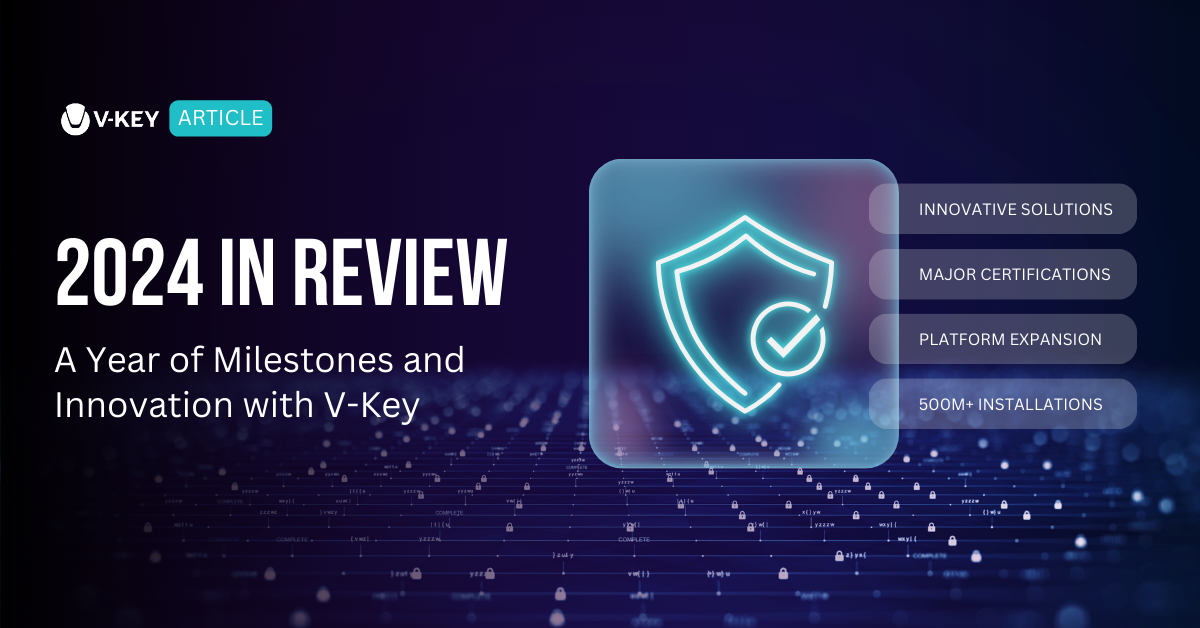
V-Key’s 2024 Journey in Advancing Digital Security and Empowering Seamless Digital Experiences

V-Key’s 2024 Journey in Advancing Digital Security and Empowering Seamless Digital Experiences

As we reflect on 2024, V-Key is proud of the milestones we’ve achieved and the innovations we’ve introduced in the…
5 Simple and Effective Ways to Secure Your Mobile App with V-OS App Shield

5 Simple and Effective Ways to Secure Your Mobile App with V-OS App Shield

For businesses, especially those handling sensitive data or financial transactions, ensuring app security is no longer optional. The risk is…
Securing Mobile Apps and Why It’s Critical for Businesses

Securing Mobile Apps and Why It’s Critical for Businesses

Mobile devices continue to become indispensable, with the average smartphone user spending around 88% of their day interacting with apps.…
Introducing V-OS App Shield: Connect, Deploy and Protect your App in Minutes

Introducing V-OS App Shield: Connect, Deploy and Protect your App in Minutes

Mobile applications are key to daily business operations, customer engagement, and overall functionality. According to Google, the average smartphone user…
V-Key partners with Bridge Alliance to build a Safer Digital Ecosystem

V-Key partners with Bridge Alliance to build a Safer Digital Ecosystem

V-Key, renowned for its advanced security solutions has proudly joined Bridge Alliance as their technology Partner,  solidifying their commitment to…
Making 2FA/MFA robust against smishing and related attacks

Making 2FA/MFA robust against smishing and related attacks

2FA/MFA was introduced to make it harder for attackers, by requiring two or more proofs of identity – also known…
How do we determine the effectiveness of mobile apps’ security systems?

How do we determine the effectiveness of mobile apps’ security systems?

With the spate of remote working regime due to Coronavirus pandemic, the reliance and growth for video conferencing platform has…
Is the detection of jailbroken/rooted phone sufficient against threats?

Is the detection of jailbroken/rooted phone sufficient against threats?

Functions that detect jailbroken/rooted devices are most commonly added to transactional mobile applications, serving as the most basic defense against…
Three steps to fight the Mobile Security status quo

Three steps to fight the Mobile Security status quo

Have financial institutions accepted a status quo that sacrifices user experience for increased security? With mobile digital identity quickly becoming…
V-OS Protection against Android Plugin malware

V-OS Protection against Android Plugin malware

There has been a recent surge in Android malware abusing Android Plugin Frameworks for malicious behavior. DroidPlugin, Parallel Space and…

V-OS Protection against CPU vulnerabilities

Virtually every computing device in the world is made unsafe by the latest disclosures on Central Processing Unit (CPU) vulnerabilities.…
The next wave of Finance: Singapore’s growing Fintech market

The next wave of Finance: Singapore’s growing Fintech market

With global cumulative investment in financial technology (fintech) forecast to exceed US$150 billion in three to five years, economies around…
Infographic: The next frontier in Banking transformation

Infographic: The next frontier in Banking transformation

As technology evolves, banks and financial institutions have no choice but to innovate. However, when it comes to security, many…
Is software-based Biometrics Authentication the solution to ASEAN’s regulatory challenges?

Is software-based Biometrics Authentication the solution to ASEAN’s regulatory challenges?

Banks in Southeast Asia should look towards software-based biometrics as the way forward to navigate the regulatory differences in the…
Building V-OS with HSM

Building V-OS with HSM

V-OS is the world’s first virtual secure element, a software solution with security built into the firmware code. These include…
Cryptography in V-OS

Cryptography in V-OS

V-OS is the world’s first virtual secure element. Cryptography plays a dual-role in these; to secure and manage the secrets…

Why Existing Mobile Software Protections are Insufficient

Recognizing that existing mobile software protections are insufficient against today’s cyber threat landscape, we take a closer look at the main…
Mobile Security that works for everyone

Mobile Security that works for everyone

Safe, convenient and simple.