Why Indonesia needs to talk about digital trust—now.
It usually begins with a simple SMS.
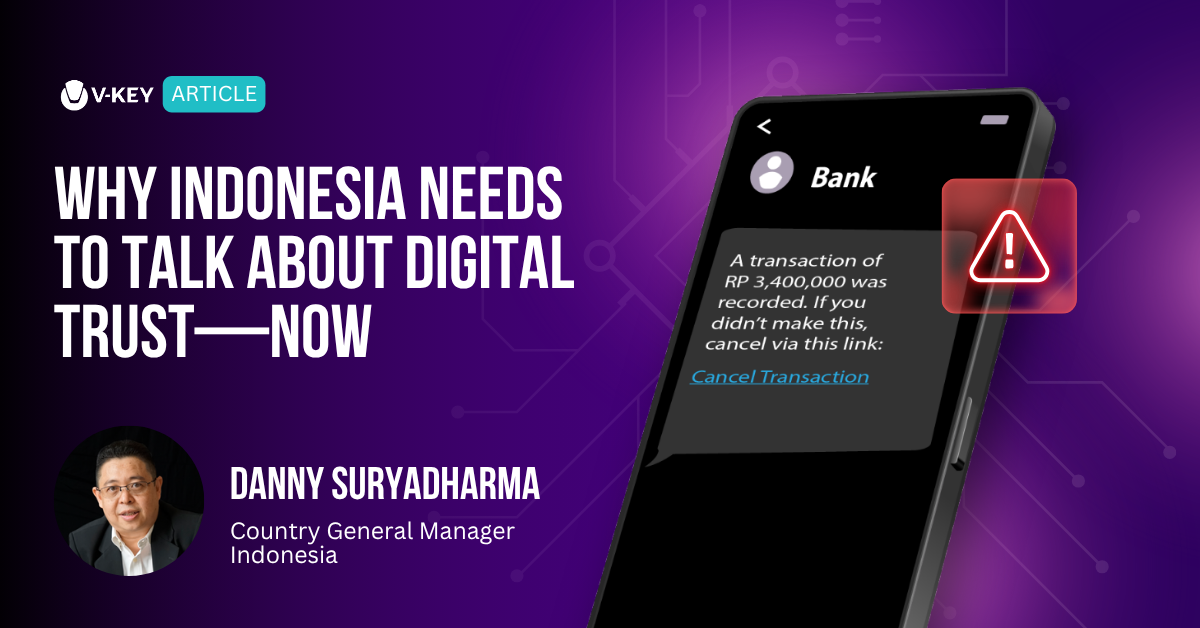
You’re going about your day, and suddenly a message arrives. The name of your bank is right there. It says your account has been suspended—or that a suspicious login attempt was detected. The logo is familiar, the words sound official, and there’s a link asking you to verify your identity.
Without thinking too much, you click. The site it opens looks just like your bank’s login page. You enter your credentials, believing you’re keeping your account safe.
Except you’re not.
You’ve just handed your information to a scammer—and within minutes, access to your account, your money, and your digital identity may be lost.
This scenario is no longer a hypothetical risk—it’s exactly what’s happening across Indonesia right now. A wave of SMS phishing attacks, often called smishing, is sweeping through, catching even the most careful people off guard.
What makes this latest wave more dangerous than before is how convincing it has become. These fake messages don’t just mimic the bank’s tone—they now appear in the same SMS thread as real bank messages. Technically, that shouldn’t be possible. But attackers are exploiting vulnerabilities in how devices treat sender names. It’s no longer just spam—it’s deception at a deeper level.
Behind the scenes, thousands of Indonesians have already fallen victim. Some lose access to their online banking. Others see money quietly withdrawn. Many only realize something is wrong when it’s too late.
It forces us to ask: how did we get here?
The truth is, our phones have evolved into more than just communication tools. They’ve become extensions of who we are. Every day, we use them to transfer money, verify our identity, pay bills, access government services, even handle our health information. Our phone is now our digital identity—and it’s under attack.
But while the threat is growing, many people still believe staying safe online is simply about being careful: don’t click suspicious links, check the sender, turn on two-factor authentication, avoid unknown apps. These are important habits—but let’s be honest. In real life, even smart users get tricked. The scams are evolving faster than the average user can keep up with.
Here’s where we need a mindset shift.
Security shouldn’t depend entirely on the user. A secure experience should feel effortless. People shouldn’t have to question every tap or link—they should simply trust that the apps and services they use are built to protect them, no matter what.
This means companies, developers, and digital service providers have a new responsibility. The real solution isn’t to train users harder, but to design systems that protect users silently and automatically.
Imagine if apps could detect when they’re being tampered with, even on rooted or jailbroken devices. Imagine if sensitive actions—like transferring funds or changing passwords—were shielded by layers of protection so deep that even if malware exists on the phone, the attacker gets nothing. Imagine if logins were verified not just by password or OTP, but also by your device’s integrity.
This kind of protection is no longer science fiction. It’s already being used quietly in the background by banks and digital platforms that prioritize trust. The average person never sees it. They just feel safe. And that’s the point.
We’re in a moment where digital transformation in Indonesia is accelerating. From e-wallets to e-KTP, digital identity is becoming the foundation of how citizens engage with services, banks, and businesses. But growth without trust is fragile. If people start to fear that their digital world can’t protect them, they will hesitate to use it.
Trust has to be built in—not just added after something goes wrong.
The recent fake SMS wave is a warning, but also a call to action. We can build a digital Indonesia where users feel empowered, not overwhelmed. Where security is not a barrier, but a silent guardian. Where trust isn’t requested, but earned—through design, technology, and shared responsibility.
Because in the end, digital trust is not just a tech issue. It’s a people issue. And it’s time we all took it seriously.
⸻
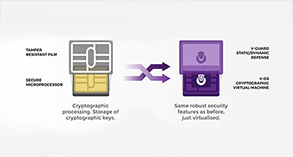
And for those quietly powering this trust from behind the screen, technologies like V-Key are already making it happen—protecting millions without making a sound. V-Key’s core product, V-OS, is a virtual secure element that safeguards apps from the inside out. It creates a tamper-proof environment within the app that validates every action, verifies sender authenticity, binds transactions to trusted devices, and ensures messages haven’t been intercepted or altered in transit. Even if the device is rooted, jailbroken, or running malware, V-OS keeps the transaction protected—ensuring the integrity of digital communication from initiation to delivery.
This isn’t just passive protection—it’s proactive trust enforcement. V-Key ensures that only authorized users on verified devices can perform high-risk actions. It also uses cryptographic identities and device attestation to reject suspicious or manipulated sessions silently.
By embedding trust at every step, V-Key helps digital services in Indonesia secure their ecosystems, build user confidence, and make digital growth sustainable. In short, it helps ensure that the message is real, the action is safe, and the trust is earned—by design.