V-Key

V-Key

V-Key

Cyber Resilience by Design: Essential Eight, APRA and the New Rules for Digital Identity in Australia

Cyber resilience in Australia has largely been talked about in terms of networks, servers and email gateways, the territory the Essential Eight was built to defend, and APRA’s prudential standards were written to govern. That’s starting to shift. A parallel conversation about resilience is now unfolding around something more personal: the identity people carry in their pocket, and the mobile apps that verify who they are. 

The clearest sign of that shift is what’s about to happen with Australia’s national Digital ID system. From 30 November 2026, private sector organisations become eligible to apply to join the Australian Government Digital ID System (AGDIS) for the first time [1][2]. Banks, insurers, telecommunications providers and other regulated entities will be able to build identity verification flows on top of a federally accredited system rather than their own bespoke onboarding processes. For CISOs, compliance leads and technology decision-makers, that’s a near-term integration decision — and one that lands squarely inside two frameworks many of these organisations already live under: the Essential Eight and APRA’s prudential standards. 

Why Cyber Resilience Now Runs Through Digital Identity 

Digital ID uptake in Australia has moved fast. As of December 2025, more than 15 million Australians held a myID, and verified transactions through AGDIS had more than tripled year-on-year to reach 80 million [2]. Trust hasn’t kept pace with adoption, though: auDA’s most recent Digital Lives of Australians research found that 71% of Australians who don’t hold a Digital ID cite security worries as the reason [3]. That’s the gap cyber resilience frameworks exist to close, and it’s a gap that now sits on the device layer as much as the network layer. 

When the primary access channel for a national identity system is a smartphone, the attack surface for identity fraud shifts with it, from forged paperwork to compromised endpoints, cloned applications, and credentials lifted through malware or overlay attacks rather than stolen wallets. The Essential Eight wasn’t written with Digital ID in mind, but the underlying problem it targets, hardening the endpoints and applications that hold sensitive access, is precisely the problem digital identity now runs on top of. 

Essential Eight: The Baseline Behind the Headlines 

The Essential Eight remains, at its core, eight prioritised mitigation strategies mapped against four maturity levels, first published by the Australian Signals Directorate in 2017 and updated regularly since [4]. It isn’t a certification, and outside non-corporate Commonwealth entities it isn’t universally mandated, but it has become a default reference point in tenders, contracts and cyber insurance assessments. 

What’s Changed Heading Into 2026 

Two shifts matter for anyone revisiting their posture this year. First, ASD has lowered the bar at which phishing-resistant MFA is required: it now applies from Maturity Level Two rather than only at the top level, and a new requirement covers phishing-resistant authentication to workstations themselves, a direct response to the rise of real-time phishing and credential-based attacks [5]. Second, ASD’s own assessment guidance now grades evidence quality explicitly, and rates a verbal or policy statement of intent as the lowest tier of evidence available; “we patch within 48 hours” needs a demonstrable audit trail behind it, not an assertion [6]. 

Where Mobile Identity Intersects With Essential Eight 

None of the Essential Eight’s strategies were written as a mobile app security specification, and no technology genuinely makes an organisation “Essential Eight compliant.” But the intent behind several of them, verified access, controlled and patched applications, hardened endpoints, maps directly onto how a digital identity credential is protected once it’s sitting inside a mobile app on a personal device. An organisation can have exemplary MFA policy on paper and still have it undermined at runtime if the app carrying the credential can be tampered with, run undetected on a compromised device, or have its communications intercepted. 

APRA’s Expectations: CPS 234, CPS 230 and Digital Identity 

For APRA-regulated entities, banks, insurers and superannuation trustees, the relevant obligations sit in two connected prudential standards. CPS 234 (Information Security) requires information security capability commensurate with the threat exposure of an entity’s information assets, holds the board ultimately accountable, and requires APRA to be notified of material information security incidents within 72 hours [7]. CPS 230 (Operational Risk Management), in force since 1 July 2025, requires entities to identify critical operations, set impact tolerances, and manage the risk posed by material service providers, including APRA’s contractual right to review documentation and conduct on-site visits [8]. Pre-existing service-provider contracts had until the earlier of their next renewal date or 1 July 2026 to be brought into line, a deadline that has now passed, meaning any digital identity provider relationship that qualifies as a material service arrangement should already meet the standard [8]. 

The connection to digital identity is direct: once a bank or insurer integrates with an external Digital ID provider, that relationship is very likely to meet the definition of a material service-provider arrangement under CPS 230, and the identity verification flow itself becomes an information asset inside CPS 234’s scope. Using an accredited, federally regulated identity system doesn’t discharge the entity’s own security and reporting obligations, it adds a dependency that has to be managed under the same standards as any other. 

Where Australia’s Digital ID Rollout Actually Stands 

The Digital ID Act 2024 came into force on 30 November 2024, establishing the Australian Competition and Consumer Commission as Digital ID Regulator overseeing accreditation, and giving the Office of the Australian Information Commissioner an expanded privacy role [1]. Amendments finalised in November 2025 strengthened the Digital ID Rules and introduced a redress framework for individuals affected by fraud or cyber security incidents within AGDIS [9]. None of that is forthcoming, it’s already operating. 

What’s still ahead is the part most relevant here: private sector entities become eligible to apply to join AGDIS from 30 November 2026, whether as accredited providers or relying parties verifying customers [1][2]. 

The practical takeaway for a bank, telco or insurer is straightforward: within the next reporting cycle, using a federally accredited Digital ID to verify a new customer stops being theoretical and becomes an option on the table, one that sits inside the Essential Eight and APRA obligations already covered above, not outside them. 

The Missing Layer: Mobile App Security as the Foundation of Digital Identity Trust 

This is where the policy story, the Essential Eight conversation and the APRA obligations converge on one practical point: none of it means much if the mobile app carrying the identity credential, biometric template or authentication key isn’t itself defensible. 

That’s the layer easiest to overlook, sitting below the policy debate and the compliance audit, inside code running on millions of individual devices, many rooted, jailbroken, or otherwise outside an organisation’s control. It’s also where the practical use cases for digital identity, eKYC onboarding, biometric login, one-tap authentication, actually live or die. An eKYC flow with a flawless liveness check is only as trustworthy as the app performing it; a passwordless method is only as phishing-resistant as the runtime protecting its keys. 

This is the specific gap that mobile app security and app-level digital identity technologies, including V-Key’s own V-OS-based approach to tamper-resistant, software-based protection, are built to address: giving mobile applications a verifiable identity of their own, and protecting the credentials inside them even when the device can’t be fully trusted. It’s a complement to Essential Eight and APRA compliance work, not a replacement for either. 

Building a Digital Identity Strategy That Can Withstand Scrutiny and Attack 

A few questions are worth answering before the 30 November 2026 opening, not after: 

  • Where do identity credentials actually live today, and how would that change once a federally accredited Digital ID provider joins the onboarding or verification flow? 
  • Does mobile app hardening reflect the intent of Essential Eight, verified access, controlled applications, protected endpoints, even where the framework isn’t formally mandated? 
  • Has any prospective Digital ID integration been assessed as a material service-provider relationship under CPS 230, with the corresponding risk register and contractual protections in place? 
  • Is information security capability for that integration commensurate with the threat, as CPS 234 expects, rather than assumed because the provider itself is accredited? 

Essential Eight and prudential standards like CPS 234 and CPS 230 are best treated as a floor for this work, not a finish line. As Australia’s digital identity system opens to a much wider set of organisations over the next twelve months, the entities that get the most value out of it, with the least regulatory and reputational risk, will be the ones that treated mobile app security as part of the same conversation as compliance from the outset. 

V-Key works with banks, telcos, government agencies and technology companies across the region on mobile app protection and digital identity infrastructure. Explore how V-Key ID and V-OS Mobile App Protection support this kind of work.


Sources & References 

  1. Department of Finance, Digital ID Act 2024, Digital ID System — commencement date (30 November 2024), ACCC as Digital ID Regulator, OAIC’s expanded privacy role, and AGDIS expansion to the private sector no later than two years after commencement.
    https://www.digitalidsystem.gov.au/what-is-digital-id/digital-id-act-2024

  2. Senator the Hon Katy Gallagher, Minister for Finance, “More than 15 million Australians choose simpler, safer Digital ID,” media release, 4 December 2025 — 15 million myIDs and 80 million verified AGDIS transactions (more than tripled year-on-year) as at that date; confirmation that private sector providers can apply to join AGDIS from 30 November 2026.
    https://ministers.finance.gov.au/financeminister/media-release/2025/12/04/more-15-million-australians-choose-simpler-safer-digital-id

  3. auDA, Digital Lives of Australians 2025 (research conducted with SEC Newgate Research) — finding that 71% of Australians without a Digital ID cite security concerns as the reason, as summarised on auDA’s website.
    https://www.auda.org.au/news-insights/blog/navigating-the-digital-lives-of-australians-challenges-and-solutions/

  4. Australian Signals Directorate / Australian Cyber Security Centre, Essential Eight Maturity Model, cyber.gov.au — framework structure (eight strategies, four maturity levels), first published June 2017 and updated regularly.
    https://www.cyber.gov.au/business-government/asds-cyber-security-frameworks/essential-eight/essential-eight-maturity-model

  5. Australian Cyber Security Centre, Essential Eight Maturity Model Changes, cyber.gov.au — addition of phishing-resistant MFA requirements at Maturity Level Two and the new workstation-authentication requirement.
    https://www.cyber.gov.au/business-government/asds-cyber-security-frameworks/essential-eight/essential-eight-maturity-model-changes

  6. Australian Cyber Security Centre, Essential Eight Assessment Process Guide, cyber.gov.au — defined evidence-quality tiers for assessment, with a verbal or policy statement of intent rated as the lowest (“poor”) tier of evidence.
    https://www.cyber.gov.au/business-government/asds-cyber-security-frameworks/essential-eight/essential-eight-assessment-process-guide

  7. Australian Prudential Regulation Authority, Prudential Standard CPS 234 Information Security.
    https://www.apra.gov.au/standards/cps-234

  8. Australian Prudential Regulation Authority, Operational Risk Management (CPS 230) — effective date (1 July 2025), material service-provider obligations, and the transitional deadline (earlier of contract renewal or 1 July 2026) for pre-existing service-provider arrangements.
    https://www.apra.gov.au/operational-risk-management

  9. Department of Finance, “Digital ID Rules updated to better support individuals,” Digital ID System — 2025 amendments to the Digital ID Rules and the introduction of the redress framework, which commenced 19 November 2025.
    https://www.digitalidsystem.gov.au/news/digital-id-rules-updated-to-better-support-individuals
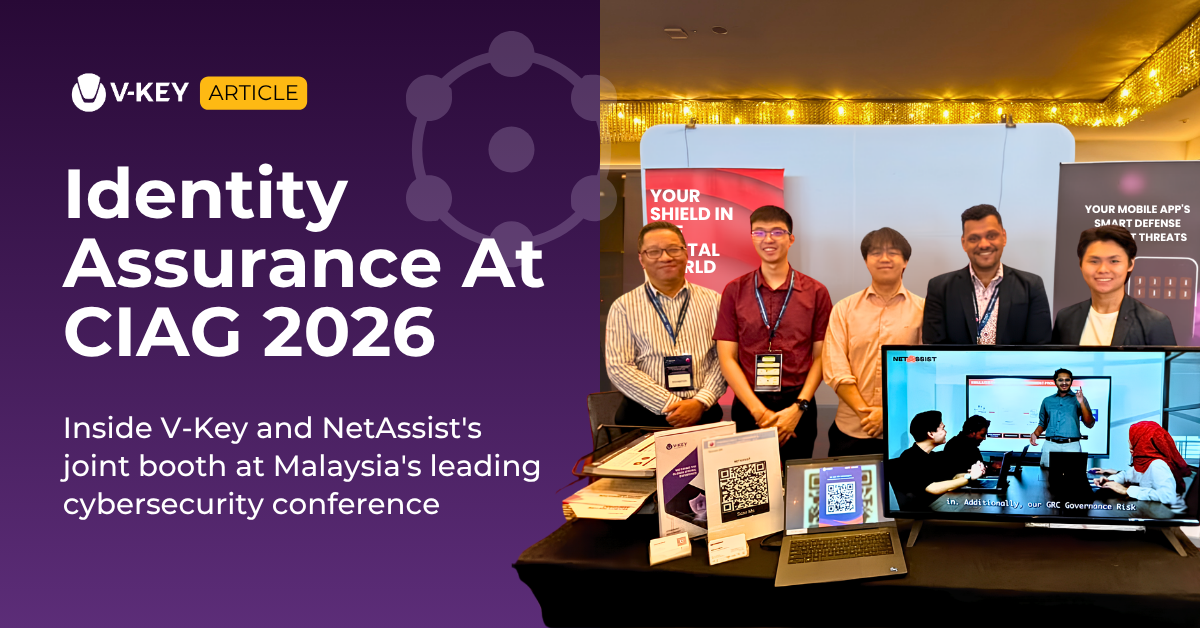
V-Key Partners with NetAssist to Bring Identity Assurance to CIAG 2026

V-Key Partners with NetAssist to Bring Identity Assurance to CIAG 2026

V-Key teamed up with NetAssist at CIAG 2026 to showcase how identity assurance and infrastructure security work together for governance…
V-Key Spotlights Digital Identity at TB-CERT 2026 

V-Key Spotlights Digital Identity at TB-CERT 2026 

V-Key joined TB-CERT Cybersecurity Annual Conference 2026 in Bangkok, showcasing V-Key ID and engaging Thailand’s banking and cybersecurity community on…
V-Key at Authenticate APAC 2026: Showcasing the Future of Digital Identity

V-Key at Authenticate APAC 2026: Showcasing the Future of Digital Identity

V-Key joined Authenticate APAC 2026 as a Gold Sponsor, showcasing V-Key ID, a digital identity platform delivering secure, passwordless authentication…
One Identity, Every Platform – V-Key at Vietnam Security Summit 2026

One Identity, Every Platform – V-Key at Vietnam Security Summit 2026

V-Key joined Vietnam Security Summit 2026 as a Bronze Sponsor, demoing V-Key ID, a digital identity solution enabling secure verification…
V-Key Granted Singapore Patent for App-to-App Mutual Trust Technology

V-Key Granted Singapore Patent for App-to-App Mutual Trust Technology

V-Key has been granted a Singapore patent for its App-to-App Mutual Trust technology, reinforcing its intellectual property position in mobile…
Protect Your Mobile App in 3 Simple Steps

Protect Your Mobile App in 3 Simple Steps

Mobile apps are now the primary channel for retail and e-commerce and a growing target for attacks. V-OS App Shield…
V-Key and Regula Deliver ​​High-Assurance​​​​ Identity Verification for Mobile

V-Key and Regula Deliver ​​High-Assurance​​​​ Identity Verification for Mobile

V-Key and Regula have joined forces to bring high-assurance identity verification to mobile apps across Asia-Pacific.The partnership embeds Regula’s document…
V-Key and Chekk Partner on Mobile-First Digital Identity

V-Key and Chekk Partner on Mobile-First Digital Identity

V-Key and Chekk have partnered to deliver a unified mobile-first identity experience — combining V-Key’s patented mobile security with Chekk’s…
Tech Titan and V-Key Partner to Bring V-OS App Shield to Singapore

Tech Titan and V-Key Partner to Bring V-OS App Shield to Singapore

V-OS App Shield is now available in Singapore through Tech Titan SG — protect your mobile apps from reverse engineering,…
Holiday Blues – Dealing with App Logins 

Holiday Blues – Dealing with App Logins 

Lunar New Year is supposed to be a season of joy, reunion dinners, pineapple tarts, and that familiar rush of…
V-Key Secures Strategic Majority Investment from Tower Capital Asia

V-Key Secures Strategic Majority Investment from Tower Capital Asia

V-Key is pleased to announce a significant new chapter in its growth journey. Tower Capital Asia (TCA) has made a…
V-Key Secures US Patent Advancing App Identity and Digital Trust

V-Key Secures US Patent Advancing App Identity and Digital Trust

V-Key is proud to announce that its patent for “Secure Module and Method for App-to-App Mutual Trust Through App-Based Identity”, …
V-Key 2025 In Review: Advancing Trusted Digital Identity

V-Key 2025 In Review: Advancing Trusted Digital Identity

2025 was a defining year for V-Key, as digital identity, cybersecurity, and artificial intelligence converged at the core of enterprise…

A Practical Approach to AI in Identity and Mobile Security

Artificial intelligence is increasingly being applied as a practical tool to improve visibility and support more efficient security operations. At…

V-OS FIDO2 Server Achieves Official FIDO2 Certification

V-Key is pleased to announce that the V-OS FIDO2 Server has officially obtained FIDO2 certification, marking a major milestone in…
Redefining Digital Identity with AI-Driven Intelligence and Trust

Redefining Digital Identity with AI-Driven Intelligence and Trust

As digital interactions expand across industries, organizations face a growing identity challenge: verifying users securely while keeping onboarding effortless and…
BSSN Common Criteria Compliance for Stronger Security

BSSN Common Criteria Compliance for Stronger Security

Indonesia’s digital economy is expanding rapidly, with financial services, telecoms, and government agencies increasingly reliant on secure digital platforms. To…
Securing Banking Through APRA Compliance with V-Key

Securing Banking Through APRA Compliance with V-Key

In Australia’s financial services sector, regulatory compliance is inseparable from trust and resilience. The Australian Prudential Regulation Authority (APRA) plays…
V-Key at COBA 2025: Strengthening Digital Identity and Compliance in Australia

V-Key at COBA 2025: Strengthening Digital Identity and Compliance in Australia

AUGUST, 2025 — The COBA 2025 Conference once again proved to be the premier gathering for Australia’s customer-owned banking sector.…

Shield in Minutes and Keep Your Mobile App Fast and Secure

Mobile apps have become the primary gateway for users to browse, purchase, book, track, earn rewards, and engage in real…

Modern Authentication in ANZ: Finding the Balance Between Security and User Experience

In Australia and New Zealand, authentication has reached a turning point.  Banking apps, telco platforms, superannuation portals, and digital health…

How to Choose the Right Authenticator

Authentication is essential for ensuring that only authorized individuals gain access while keeping unauthorized users out.
Navigating Business, Technology and Trust: V-Key at AIBP Malaysia 2025

The AIBP Conference & Exhibition 2025 in Kuala Lumpur brought together decision-makers from across the financial services, enterprise, and technology…
V-Key Expands to Japan, Enhancing Mobile App and Digital Identity Security

V-Key Expands to Japan, Enhancing Mobile App and Digital Identity Security

2025 June — V-Key is expanding into Japan, bringing trusted digital identity and mobile app protection to one of the…
Built for RMiT, Securing Malaysia’s Financial Future with V-Key

Built for RMiT, Securing Malaysia’s Financial Future with V-Key

More than just a requirement, compliance is what helps businesses stay strong and keep customer trust intact. This is especially…
How V-Key ID Enhances Banking Security

How V-Key ID Enhances Banking Security

In Australia’s highly regulated financial environment, robust digital identity and authentication controls aren’t just best practice, they’re a compliance imperative.…
Why Developers Shouldn’t Have to Choose Between Speed and Security
Why Developers Shouldn’t Have to Choose Between Speed and Security

Mobile development moves fast. There are always new features to launch, bugs to fix, and deadlines to meet—and developers are…
The Real Cost of Mobile App Breaches and How to Stay Ahead of Threats

The Real Cost of Mobile App Breaches and How to Stay Ahead of Threats

Mobile apps have become the primary engagement channel for modern businesses. Whether it’s a healthcare portal, an e-commerce platform, a…
The Fake SMS That Looks Real

The Fake SMS That Looks Real

Why Indonesia needs to talk about digital trust—now.  It usually begins with a simple SMS. You’re going about your day,…
Building Digital Trust with V-Key at the State Bank of Vietnam Event 

Building Digital Trust with V-Key at the State Bank of Vietnam Event 

2025 April, Vietnam –  V-Key had the privilege of participating in the State Bank of Vietnam (SBV) CIO Roundtable event…
Journey to  Passwordless Authentication

Journey to Passwordless Authentication

Is it the Beginning of the End of Passwords?  In the wake of cyber-attacks at some of the biggest Superannuation…
Vietnam’s New Digital Security Regulations: Strengthening Mobile and Biometric Protections

Vietnam’s New Digital Security Regulations: Strengthening Mobile and Biometric Protections

Vietnam is rapidly enhancing its digital security landscape. In just the past six months, two major regulations—Decision 2345 (effective July…
Mobile Malware Landscape in 2024: Why App Security Is Critical for Businesses

Mobile Malware Landscape in 2024: Why App Security Is Critical for Businesses

Mobile malware attacks are rising as mobile banking, digital payments, and remote authentication become mainstream. In 2024, over 33.3 million…
Strengthening Australia’s Digital Identity Future 

Strengthening Australia’s Digital Identity Future 

Australia is making significant progress in digital identity adoption, with the federal government leading efforts through its national Digital ID…
Beyond OTPs: The Shift to Passwordless Authentication in Banking

Beyond OTPs: The Shift to Passwordless Authentication in Banking

The Bangko Sentral ng Pilipinas (BSP) is considering phasing out one-time passwords (OTPs) for digital banking transactions, citing the growing…
V-Key Continues to Expand in Australia to Strengthen Digital Identity and Authentication

V-Key Continues to Expand in Australia to Strengthen Digital Identity and Authentication

V-Key strengthens its presence in Australia by participating in the FIDO Alliance events in Melbourne, reinforcing its commitment to digital…
Why Passwordless Authentication is the Future of Security

Why Passwordless Authentication is the Future of Security

Managing passwords can be challenging. They can be difficult to remember, and often, people reuse them across multiple sites, which…
Protect Your Business All Year with V-Key ID and FIDO2

Protect Your Business All Year with V-Key ID and FIDO2

Lunar New Year is a time for celebration for many people around the world, but it’s also a good opportunity…
V-Key’s 2024 Journey in Advancing Digital Security and Empowering Seamless Digital Experiences

V-Key’s 2024 Journey in Advancing Digital Security and Empowering Seamless Digital Experiences

As we reflect on 2024, V-Key is proud of the milestones we’ve achieved and the innovations we’ve introduced in the…
5 Simple and Effective Ways to Secure Your Mobile App with V-OS App Shield

5 Simple and Effective Ways to Secure Your Mobile App with V-OS App Shield

For businesses, especially those handling sensitive data or financial transactions, ensuring app security is no longer optional. The risk is…
Securing Mobile Apps and Why It’s Critical for Businesses

Securing Mobile Apps and Why It’s Critical for Businesses

Mobile devices continue to become indispensable, with the average smartphone user spending around 88% of their day interacting with apps.…
Introducing V-OS App Shield: Connect, Deploy and Protect your App in Minutes

Introducing V-OS App Shield: Connect, Deploy and Protect your App in Minutes

Mobile applications are key to daily business operations, customer engagement, and overall functionality. According to Google, the average smartphone user…
V-Key partners with Bridge Alliance to build a Safer Digital Ecosystem

V-Key partners with Bridge Alliance to build a Safer Digital Ecosystem

V-Key, renowned for its advanced security solutions has proudly joined Bridge Alliance as their technology Partner,  solidifying their commitment to…
Making 2FA/MFA robust against smishing and related attacks

Making 2FA/MFA robust against smishing and related attacks

2FA/MFA was introduced to make it harder for attackers, by requiring two or more proofs of identity – also known…
How do we determine the effectiveness of mobile apps’ security systems?

How do we determine the effectiveness of mobile apps’ security systems?

With the spate of remote working regime due to Coronavirus pandemic, the reliance and growth for video conferencing platform has…
Is the detection of jailbroken/rooted phone sufficient against threats?

Is the detection of jailbroken/rooted phone sufficient against threats?

Functions that detect jailbroken/rooted devices are most commonly added to transactional mobile applications, serving as the most basic defense against…
Three steps to fight the Mobile Security status quo

Three steps to fight the Mobile Security status quo

Have financial institutions accepted a status quo that sacrifices user experience for increased security? With mobile digital identity quickly becoming…
V-OS Protection against Android Plugin malware

V-OS Protection against Android Plugin malware

There has been a recent surge in Android malware abusing Android Plugin Frameworks for malicious behavior. DroidPlugin, Parallel Space and…

V-OS Protection against CPU vulnerabilities

Virtually every computing device in the world is made unsafe by the latest disclosures on Central Processing Unit (CPU) vulnerabilities.…
The next wave of Finance: Singapore’s growing Fintech market

The next wave of Finance: Singapore’s growing Fintech market

With global cumulative investment in financial technology (fintech) forecast to exceed US$150 billion in three to five years, economies around…
Infographic: The next frontier in Banking transformation

Infographic: The next frontier in Banking transformation

As technology evolves, banks and financial institutions have no choice but to innovate. However, when it comes to security, many…
Is software-based Biometrics Authentication the solution to ASEAN’s regulatory challenges?

Is software-based Biometrics Authentication the solution to ASEAN’s regulatory challenges?

Banks in Southeast Asia should look towards software-based biometrics as the way forward to navigate the regulatory differences in the…
How does a Virtual Smart card protect a customer if they lose or change their mobile phone?

How does a Virtual Smart card protect a customer if they lose or change their mobile phone?

From banks to government agencies, many organisations are intrigued by and exploring software security solutions such as mobile tokens and…
Building V-OS with HSM

Building V-OS with HSM

V-OS is the world’s first virtual secure element, a software solution with security built into the firmware code. These include…
Cryptography in V-OS

Cryptography in V-OS

V-OS is the world’s first virtual secure element. Cryptography plays a dual-role in these; to secure and manage the secrets…

Why Existing Mobile Software Protections are Insufficient

Recognizing that existing mobile software protections are insufficient against today’s cyber threat landscape, we take a closer look at the main…
Mobile Security that works for everyone

Mobile Security that works for everyone

Safe, convenient and simple.