Key Takeaways
- Identity providers (IdPs) give organizations a secure way to check who a user is and let them into digital services.
- Modern IdPs make things safer and easier for users by using tools like Single Sign On, Multi Factor Authentication, passwordless authentication, and federated identity.
- Enterprises, telecoms, governments, fintechs, and banks all count on IdPs to handle authentication and identity verification.
- The future of digital identity relies on new tech like passkeys, biometric authentication, mobile identity wallets, and mobile app protection.
Introduction
Everything is moving to mobile. Whether you are dealing with banking, government services, fintech, telecom, or large enterprise platforms, digital trust is a critical priority. Users want fast access to their accounts, but they also want confidence that their data is protected.
That is why we use identity providers. If you are evaluating your security setup and asking what IdP is, here is a clear answer. An Identity Provider (IdP) is just the system that checks a user’s identity before letting them use an application, platform, or online service.
Modern enterprises require an appropriate identity provider to manage digital identity frameworks, authorization, and secure authentication. An IdP guarantees that an authorized individual is initiating the action, whether that involves logging into mobile banking platforms, utilizing government services, or signing off on monetary transactions.
Organizations are channeling significant resources into robust identity defenses to counter the daily escalation of cyber threats. Microsoft’s 2025 Digital Defense Reports found it blocked more than 7,000 password attacks per second, underscoring how exposed password-based logins remain. This is a key reason more businesses are moving toward passkeys and passwordless authentication.
What Is an Identity Provider (IdP)?
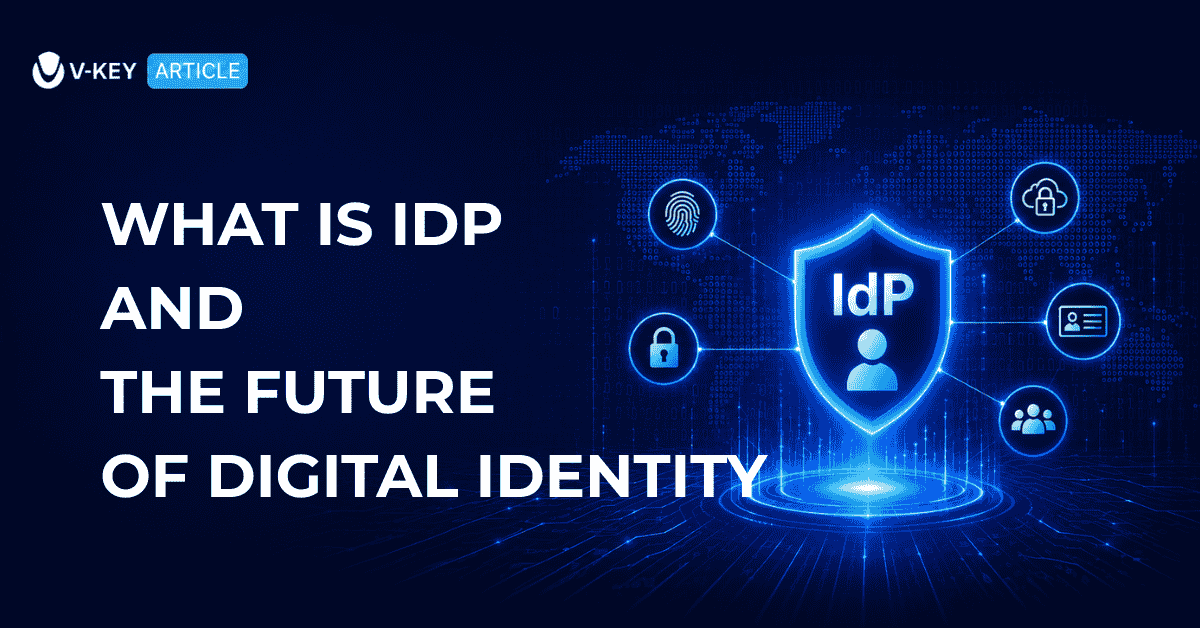
An Identity Provider, or IdP, operates as a protected gateway designed to execute user authentication and safely transmit those validated details to the specific platforms or applications you are trying to open.
In practical terms, it is simply the gatekeeping technology that confirms your identity before a platform grants you entry.
Imagine the operational risk if every digital tool had to independently store and oversee your login information. An identity provider solves this issue by handling the verification workflow from one central spot. The moment the IdP finishes verifying your identity, it passes an identity assertion, token, or credential over to the requesting application.
An identity provider regularly utilizes several core technologies, including:
- OpenID Connect
- SAML
- Federated identity frameworks
- Passwordless authentication systems
This approach improves security while making the login experience easier for users.
How Does an Identity Provider Work?
1. User Requests Access
A user attempts to log in to an application, website, or digital service.
2. App Redirects to the IdP
The application sends the user to the identity provider for authentication.
3. IdP Verifies the User
The IdP verifies identity using methods such as:
- Passwords
- MFA
- Biometric authentication
- Passkeys
- Device trust checks
- Identity verification processes
4. IdP Issues a Token or Assertion
After successful authentication, the IdP generates a secure token or assertion using standards such as SAML or OpenID Connect, often alongside OAuth to handle authorization.
5. App Grants Access
The application validates the token and grants access to the user.
This process allows organizations to maintain strong security while reducing friction during login.
Why Identity Providers Matter
Identity providers deliver quantifiable operational advantages to organizations.
To look at a practical scenario, IdPs assist financial institutions in satisfying regulatory mandates for authentication while simultaneously minimizing user friction. They allow fintech operations to accelerate consumer onboarding, empower public sector agencies to safeguard critical citizen services, and help enterprises extend secure, mobile-first identity verification to their customers.
Benefits include:
- Stronger authentication security
- Better user experience
- Reduced password-related support costs
- Faster onboarding
- Improved regulatory compliance
- Support for Zero Trust security strategies
- Better protection against phishing and account takeover
As organizations expand digital services, trusted identity becomes the foundation of secure customer interactions.
Core Functions of an IdP
Contemporary identity providers handle tasks that extend far beyond simply validating traditional passwords and usernames.
- Authentication: This initial process confirms the true identity of a user before granting entry to any system.
- Single Sign-On (SSO): This capability enables individuals to log in a single time to gain entry to various applications, eliminating the need for repeated login prompts.
- Multi-Factor Authentication (MFA): This feature introduces extra layers of protection by utilizing:
- One-time passwords
- Security keys
- Biometrics
- Mobile authentication
- Device Trust: IdPs can evaluate whether a device is trusted before granting access.
- Policy-Based Access Control: Organizations can apply security policies based on:
- User role
- Location
- Device type
- Risk level
- Identity Federation: Federated identity enables trusted authentication across multiple organizations and systems without requiring separate credentials.
IdP vs SSO
Many people use these terms interchangeably, but they serve different purposes.
Think of it this way:
| Technology | Primary Purpose | Function |
|---|---|---|
| IdP | Verify identity | Authenticates users and issues identity assertions |
| SSO | Simplify login experiences | Allows access to multiple applications using one login session |
- The IdP verifies who you are.
- SSO makes access easier after authentication.
Together, they form the foundation of modern identity security.
IdP Use Cases for Regulated Industries
Banking
Banks use identity providers for:
- Mobile banking login
- Transaction approval
- Fraud prevention
- Customer authentication
Combining MFA, biometric authentication, and device trust helps reduce account takeover risks.
Fintech
Fintech organizations use IdPs to support:
- eKYC onboarding
- Identity verification
- Regulatory compliance
- Secure customer access
Fast onboarding is important, but security cannot be compromised.
Government
Government agencies use IdPs to secure:
- Citizen portals
- Tax services
- Benefits systems
- Digital public services
Strong authentication helps protect sensitive citizen data.
Telecoms
Telecom providers face increasing account takeover threats.
Identity providers help protect telecom accounts through:
- Strong identity verification
- Trusted device authentication
- Phishing-resistant authentication
- MFA
- Passwordless authentication
These controls reduce fraudulent account access and improve customer protection.
Enterprises
Organizations use IdPs to secure:
- Employee applications
- Cloud services
- Remote workforce access
Identity-centric security is becoming increasingly important as hybrid work continues to expand.
The Future of IdP and Digital Identity
Digital identity is evolving rapidly.
-
Passkeys
Passkeys rank among the most crucial breakthroughs in modern authentication. They phase out standard passwords entirely, swapping them for cryptographic credentials that rely on device-based authentication or biometrics for security.
Insights shared by Microsoft indicate that approximately one million passkeys are created on a daily basis. Furthermore, passkey authentication achieves a 98% login success rate, a stark contrast to the 32% success rate typically seen with password-reliant logins.
-
Biometrics
The ongoing advancement of facial recognition, alongside device-based biometrics like fingerprint, plays a vital role in increasing protection while making access more convenient.
Adopting biometric authentication lowers the heavy reliance on passwords and creates a much smoother journey for the user.
-
Mobile Identity Wallets
Mobile identity wallets are becoming central to how people prove who they are, from banking apps to national digital ID programs. As adoption grows, the security technology underpinning these wallets becomes just as important as the wallets themselves, protecting the identity data and transactions they carry.
-
Mobile App Security
Identity alone is no longer enough.
Organizations increasingly combine identity providers with:
- App protection
- Runtime security
- Fraud detection
- Device integrity verification
- Risk-based authentication
These controls help defend against malware, account takeover, and mobile fraud. V-Key Shield delivers mobile app protection powered by V-Key’s patented Virtual Secure Element (VSE). When paired with V-Key Identity, organizations gain end-to-end coverage across authentication, identity verification, and app-layer security.
-
Zero Trust
The future of digital identity aligns closely with Zero Trust principles.
Instead of assuming trust, organizations continuously verify users, devices, and apps before granting access.
Identity becomes the new security perimeter.
Conclusion
Grasping the exact concept of what is IdP has become a requirement for any enterprise designing safe online interactions.
Dependable identity providers serve as the core engine for checking user access and safeguarding transactions across multiple systems, and applications. This infrastructure underpins the entire setup for user authentication, authorization, and interconnected environments utilizing SSO, MFA, federated identity, OAuth, OpenID Connect, and SAML.
Securing digital interactions requires more than credential validation alone. Forward-thinking enterprises in banking, fintech, and government are integrating their identity providers with mobile app protection, risk-based authentication, biometric verification, passkeys, and device trust, building a layered security architecture that addresses threats across every touchpoint.
V-Key brings both sides of this equation together. V-Key Identity delivers trusted digital identity solutions for authentication and identity verification, while V-Key Shield provides mobile app protection. Together, they give regulated enterprises the security posture and audit-ready compliance documentation they need.
Frequently Asked Questions
How does an IdP support Zero Trust architecture?
What is an IdP in cybersecurity?
Is IdP the same as SSO?
What is the difference between an IdP and mobile app security?
Why do banks need an IdP with mobile app protection?
Protect your business with V-Key mobile app security and digital identity solutions.
Contact Us to strengthen authentication, biometrics, MFA, and eKYC security.