V-Key

V-Key

V-Key

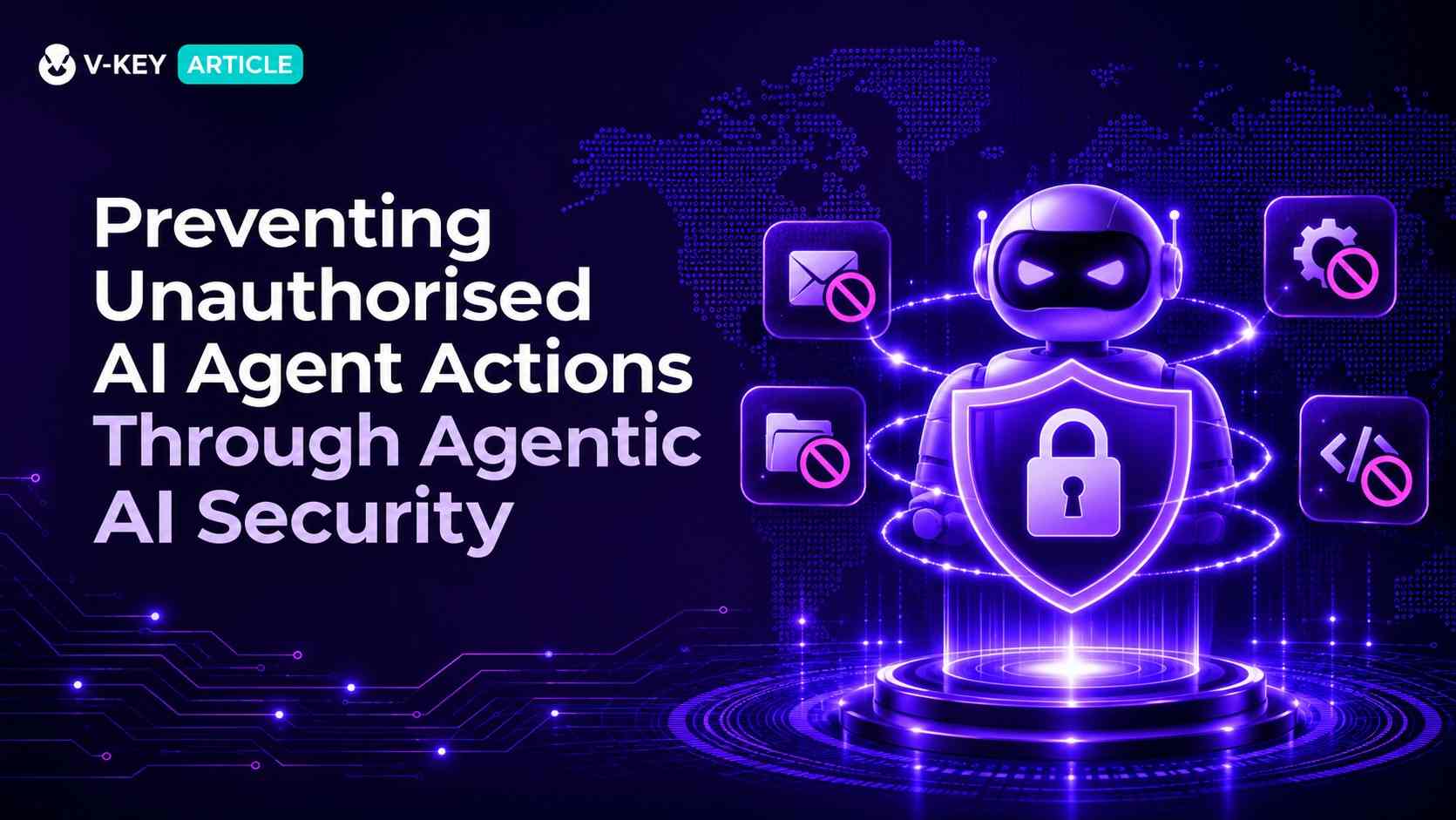
Preventing Unauthorised AI Agent Actions Through Agentic AI Security

Key Takeaways

  • Every autonomous AI agent needs a verifiable, cryptographic identity instead of generic API keys to ensure accountability.
  • Limit operational risks by enforcing least-privilege access and bounding permissions strictly to individual tasks per request.
  • Balance operational autonomy with critical oversight by requiring human approval gates for high-risk or irreversible actions.
  • Align security architectures with regional frameworks like Singapore’s Model AI Governance Framework for Agentic AI.

Introduction

Autonomous AI agents are moving beyond pilot projects. Drafting emails and summarising meeting notes is now routine. Now they’re carrying out tasks, working directly with enterprise systems and getting into sensitive business information across your digital ecosystem.

But more autonomy brings new security risks. Once a system acts by itself, a small gap in permissions can escalate into a large vulnerability. This makes robust agentic AI security essential for modern operations. Smooth operation matters, and so does confidence that AI agents will operate within their authorised boundaries.

Agent identity, authorisation and accountability can’t sit in the background any more. They’re the foundation of secure digital transformation, and legitimate AI-driven operations carry on without the brakes being applied.

What Is Agentic AI Security?

Protecting autonomous AI systems across their operational lifecycle takes a specialised layer, and that’s agentic AI security. It spans initial deployment, tool invocation, multi-agent communication and task completion.

For networks and cloud infrastructure, traditional cybersecurity controls are as vital as ever. But they often can’t keep up with autonomous agent behaviour. Standard firewalls and identity tools are built around predictable human user patterns or static application requests. AI agents work differently. They’ll decide dynamically to chain several tool calls, work through complex workflows or interpret unstructured data, which those tools are not designed to handle.

How Unauthorised AI Agent Actions Threaten Enterprise Security

An agent can easily take unintended or unauthorised actions when its identities, permissions, instructions or interactions aren’t properly backed up. Loose boundaries and agents that make their own decisions are an unsafe combination.

Excessive Permissions and Privilege Escalation 

AI agents often receive broad, standing permissions during initial setup just for the sake of convenience. This leaves them capable of acting far beyond any single task. Extra rights get misused in two ways. The agent does it, or an attacker who’s compromised the agent does it, and either way they end up in core systems and sensitive data they were never meant to touch. Scope permissions tightly to the specific task and you establish the core defence.

AI Agent Impersonation and Identity Spoofing

A trusted agent with no verifiable identity is easy to copy. One agent or a malicious actor can pose as it to gain access or give instructions. Downstream systems and APIs can’t tell the difference when agent identities are spoofed, so unauthorised actions seem completely legitimate. Cryptographic agent identity is what lets systems confirm an agent is genuine before trusting it with a single command.

Prompt Injection and Agent Goal Hijacking

Prompt injection hides malicious instructions inside the data, documents or web content an agent takes in during its routine operations. Once the agent reads that poisoned input, it can lose its goal entirely. The system ends up exfiltrating data, calling tools it shouldn’t or taking harmful actions, yet it looks like it’s doing as it’s told. Limiting the blast radius comes down to input validation, instruction isolation and strict authorisation checks on every single action.

Unauthorised Tool Usage and Data Access

Agents rely on a range of tools, APIs and data sources to do their jobs. Weak controls let them invoke tools or read data far outside their assigned scope. When an agent chains tool calls together to reach sensitive systems indirectly, security teams face a tricky puzzle. With task-based authorisation, each request has a fixed list of tools and data the agent may use, which keeps everyone in check.

Insecure Agent-to-Agent Communication 

Tasks and data flow between agents in multi-agent systems nonstop. Malicious actors can intercept, alter or inject messages if the channels aren’t secured. Quickly, a single compromised or spoofed agent corrupts an entire ecosystem of trusting agents. Forged or tampered instructions can’t spread once agents verify each other and every message is signed and checked.

Key Security Controls to Prevent Unauthorised AI Agent Actions

Enterprise AI workflows that are legitimate shouldn’t have to slow down. With the right technical controls in place, unauthorised activities are kept in check and the work carries on.

Establish Trusted Identity for Every AI Agent

Systems can only verify exactly which agent is acting if each one has a unique, cryptographic identity and not a shared API key. Authorisation, auditing and accountability all stand on that verifiable identity. No action is trusted until the system’s established that the acting agent is genuine.

Enforce Least-Privilege Access and Task-Based Authorisation

Default permissions invite unnecessary risk. Agents should get only the exact permissions the specific task at hand needs, granted per request rather than as broad standing access. And if one experiences a security compromise, task-based authorisation confines what it can do.

Apply Zero Trust Principles to AI Agent Interactions

Zero Trust boils down to “never trust, always verify”, and it applies to AI agents just as much. Every action and request gets continuous authentication and authorisation, wherever it comes from. An agent that’s been subverted can’t move sideways for long if its identity, context and intent are verified all the time.

Implement Human Approval for High-Risk Actions

Agents still work on their own for routine tasks, and approval gates escalate the consequential ones. Big moves like funds, infrastructure configurations and regulated data get human-in-the-loop approval before they execute. It’s a fair balance between autonomy and accountability, and everyday workflows don’t hit a wall.

Monitor Agent Activities and Maintain Audit Trails 

Incident response and regulatory compliance depend on solid audit trails, so every agent action should go into a tamper-resistant one. Link each entry directly to the agent identity and the responsible human. Continuous monitoring then picks up anomalous behaviour in real time, including unusual tool calls, off-scope data access and abnormal volumes.

Revoke Access and Contain Unauthorised Behaviour

Anomalous behaviour or signs of compromise mean an agent’s access should be revoked and the agent isolated immediately. Unauthorised actions stop right in their tracks once effective containment measures are in place, such as killing sessions, rotating credentials and quarantining the agent. All of this relies entirely on the per-agent identity established at the start, because that’s what makes revocation fast.

Take an AI agent that handles customer refunds. It’s partway through a standard $50 reimbursement when a prompt-injected document tells it to send $5,000 to an external account. Nothing stops it, since it doesn’t have least-privilege access or task-based authorisation, so it tries the API call. The security layer steps in. It sees the amount is over the authorised spending threshold and pauses the workflow, then a human approval gate takes over and the enterprise is protected from financial loss.

Agentic AI Security and Governance Requirements in Singapore

When it comes to responsible technology adoption, Singapore’s still out in front. The world’s first Model AI Governance Framework for Agentic AI came from the Infocomm Media Development Authority (IMDA), and it stresses three things: assessing risks upfront, making humans meaningfully accountable and implementing rigorous technical controls.

The Monetary Authority of Singapore (MAS) has a similar message for financial institutions deploying advanced artificial intelligence. Manage risk robustly. Organisations working in this landscape should make sure their agentic AI security measures align with these evolving compliance expectations.

How Agentic Identity Strengthens AI Agent Security 

V-Key’s agentic identity approach strengthens AI agent security within mobile applications, bridging the gap between machine autonomy and enterprise-grade trust. Designed for mobile apps, it keeps your digital workforce accountable at every step of the journey, and that’s down to agentic identity, an identity-centred security approach that establishes whether an AI agent running within a mobile app is genuine, authorised for a specific task and traceable back to a responsible human.

When agent identity verification, delegated authorisation and clear accountability are connected, organisations gain a stronger, auditable security posture for their mobile apps.

V-Key Identity delivers digital identity solutions that establish trusted, verifiable identity. V-Key’s approach is built on its patented Virtual Secure Element (VSE), certified to FIPS 140-2 and Common Criteria EAL3+.

Best Practices for Implementing Agentic AI Security in Enterprises

If you’re a CISO, AI Security Architect or part of a DevSecOps team, this practical checklist will help you secure your autonomous deployments:

  • Discover and catalogue every deployed AI agent and multi-agent workflow across your environment.
  • Do not rely on shared API keys. Give each agent a unique cryptographic identity instead.
  • Scope permissions tightly. Use task-based authorisation and least-privilege principles.
  • Require human-in-the-loop checkpoints for any irreversible or high-risk actions.
  • Real-time monitoring and tamper-resistant logging make anomaly detection possible.

Secure Autonomous AI Operations with V-Key

Enterprises shouldn’t permit sensitive business operations until they’ve established trust and accountability for their AI agents. Once that’s done, robust cryptographic identities and intelligent authorisation controls, used together, put your business in a position to embrace autonomy with greater confidence.

Frequently Asked Questions

Who is accountable when an AI agent makes a mistake?
The deploying organisation and the responsible human supervisor remain accountable for the outcomes produced by their AI agents.
Is an API key enough to identify an AI agent?
No. API keys lack granular context and can easily be leaked or shared, making unique cryptographic identities essential.
Do agents need human approval for every action?
No. Routine tasks run autonomously, while high-risk, irreversible, or out-of-bounds actions trigger human-in-the-loop review gates.
How do I secure agents bought from third-party vendors?
Enforce strict vendor due diligence, require transparent capability disclosures, and isolate third-party agents within well-defined permission boundaries.
Are Singapore’s agentic AI guidelines mandatory?
They serve as voluntary guidance, though they set the benchmark for regulatory expectations and responsible governance across industries.

Ready to secure autonomous AI operations?

Establish trusted identity and accountability for every AI agent with V-Key.
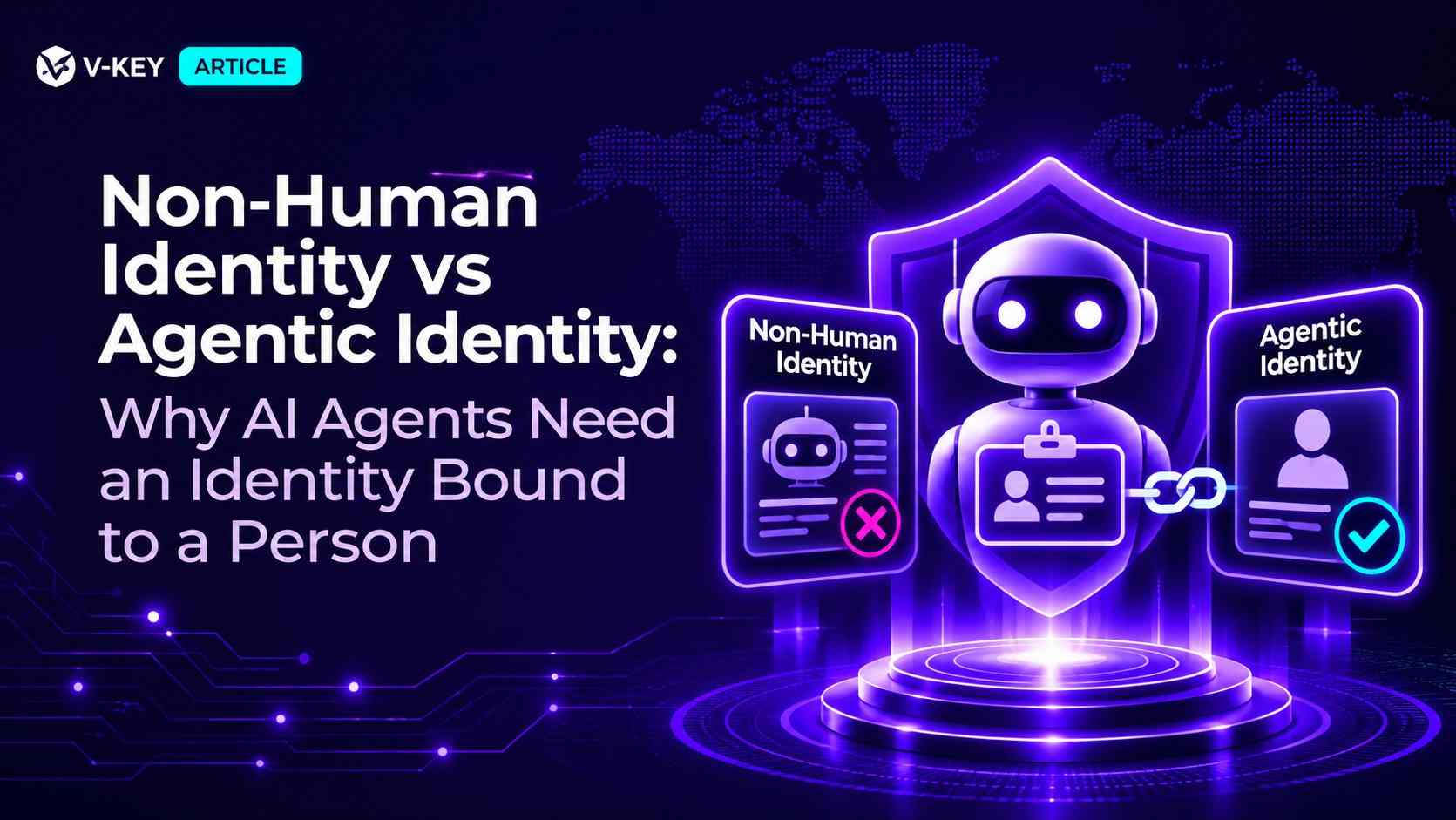
Non-Human Identity vs Agentic Identity: Why AI Agents Need an Identity Bound to a Person

Non-Human Identity vs Agentic Identity: Why AI Agents Need an Identity Bound to a Person

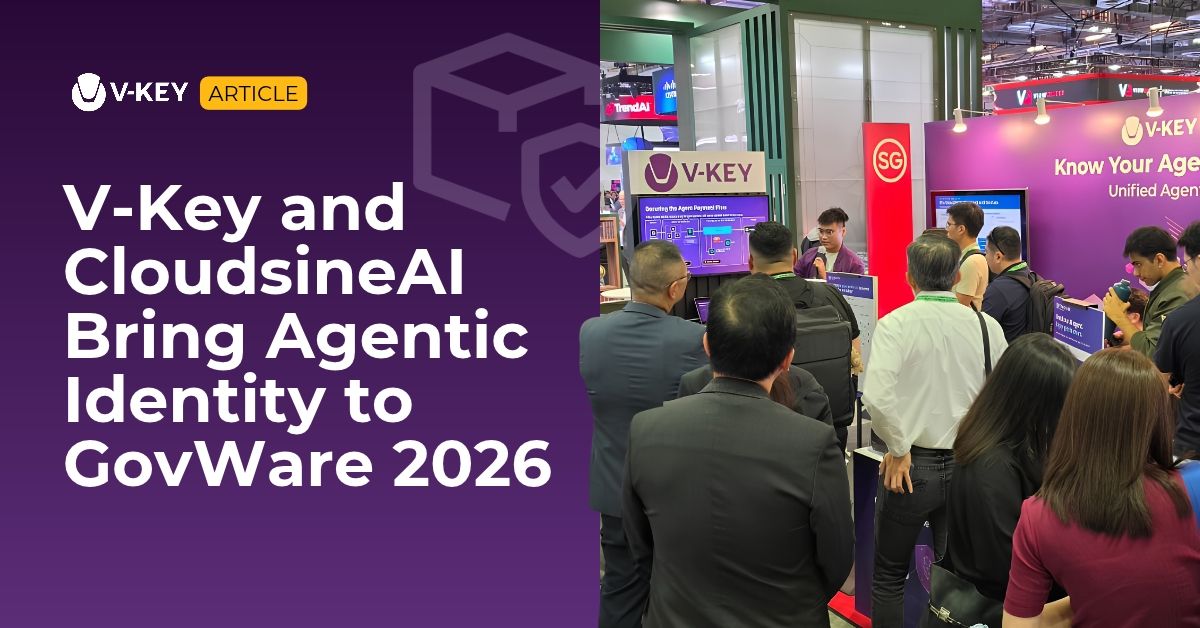
V-Key and CloudsineAI Bring Agentic Identity to GovWare 2026

V-Key and CloudsineAI Bring Agentic Identity to GovWare 2026

As AI agents begin to pay, log in and act on our behalf, who is accountable for what they do?…
V-Key Announces Strategic Majority Investment in CloudsineAI to Advance AI Safety

V-Key Announces Strategic Majority Investment in CloudsineAI to Advance AI Safety

V-Key has made a strategic majority investment in CloudsineAI, bringing trusted digital identity and agentic AI security together to advance…
Cyber Resilience by Design: Essential Eight, APRA and the New Rules for Digital Identity in Australia

Cyber Resilience by Design: Essential Eight, APRA and the New Rules for Digital Identity in Australia

Australia’s Digital ID system opens to private-sector organisations on 30 November 2026, a milestone that lands right inside obligations banks,…
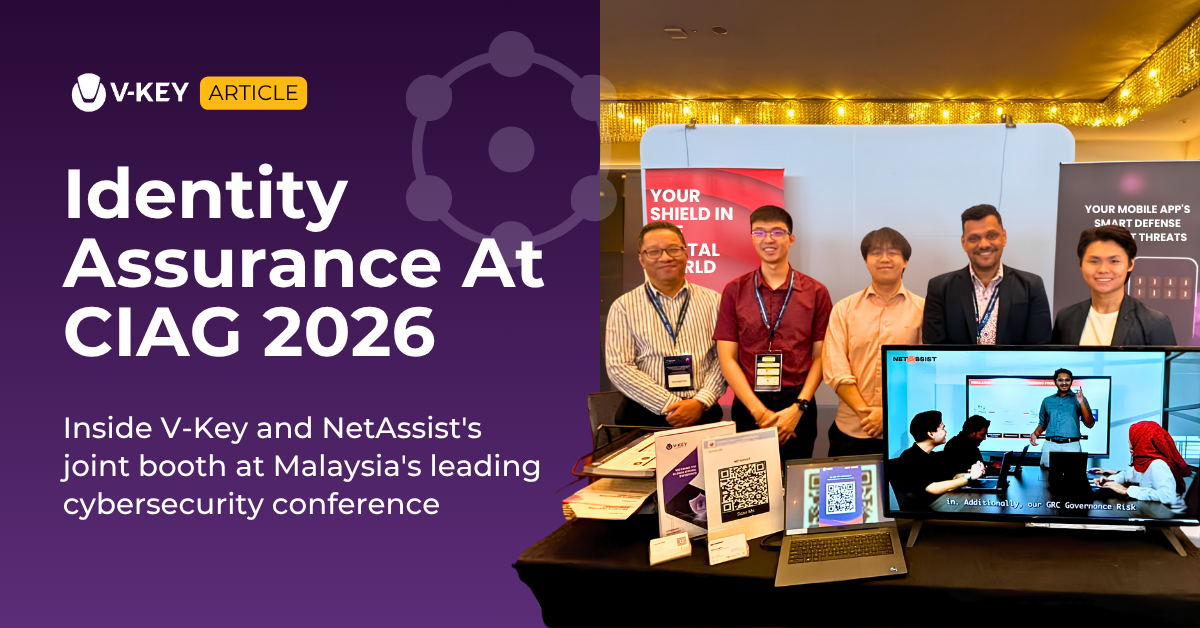
V-Key Partners with NetAssist to Bring Identity Assurance to CIAG 2026

V-Key Partners with NetAssist to Bring Identity Assurance to CIAG 2026

V-Key teamed up with NetAssist at CIAG 2026 to showcase how identity assurance and infrastructure security work together for governance…
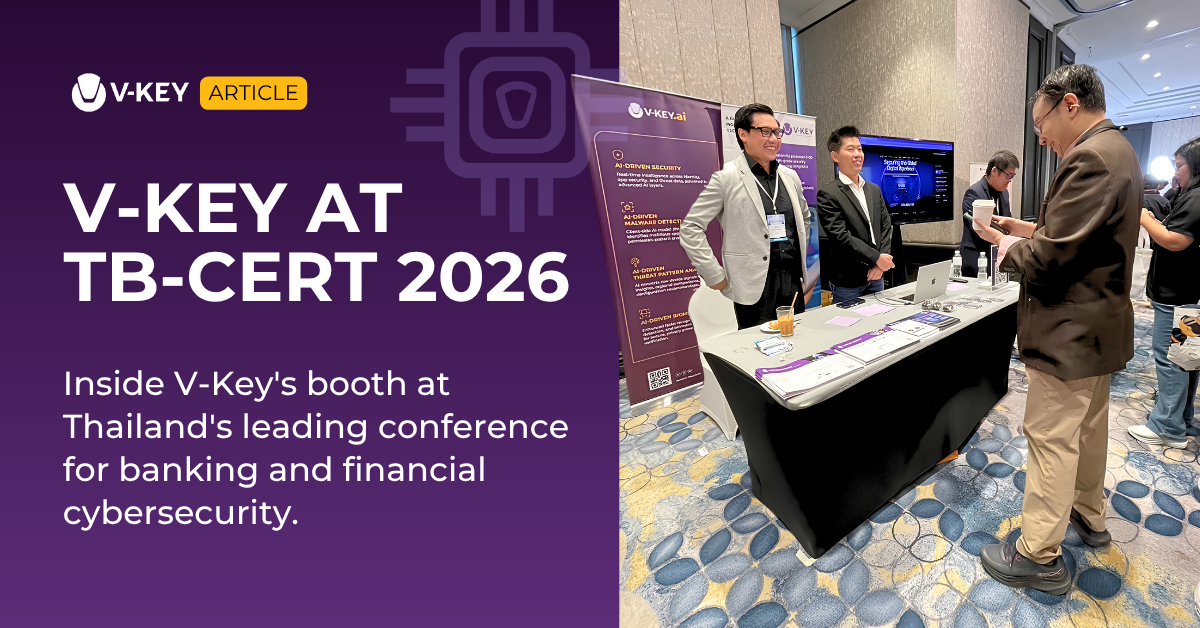
V-Key Spotlights Digital Identity at TB-CERT 2026 

V-Key Spotlights Digital Identity at TB-CERT 2026 

V-Key joined TB-CERT Cybersecurity Annual Conference 2026 in Bangkok, showcasing V-Key ID and engaging Thailand’s banking and cybersecurity community on…
What Is IdP and the Future of Digital Identity

What Is IdP and the Future of Digital Identity

Identity providers (IdPs) give organizations a secure way to check who a user is and let them into digital services.…
What Is eKYC? Process, Benefits, and Use Cases for Regulated Industries

What Is eKYC? Process, Benefits, and Use Cases for Regulated Industries

Digital verification gets customers signed up and verified in a fraction of the time. Liveness checks and biometric face scans…
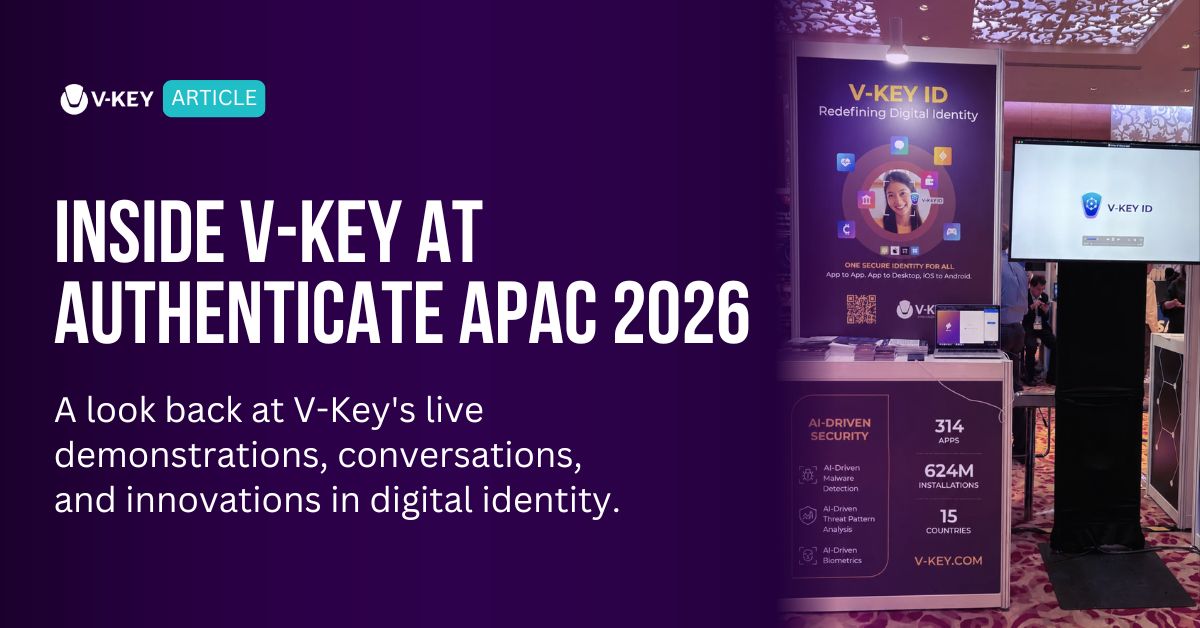
V-Key at Authenticate APAC 2026: Showcasing the Future of Digital Identity

V-Key at Authenticate APAC 2026: Showcasing the Future of Digital Identity

V-Key joined Authenticate APAC 2026 as a Gold Sponsor, showcasing V-Key ID, a digital identity platform delivering secure, passwordless authentication…
Holiday Blues – Dealing with App Logins 

Holiday Blues – Dealing with App Logins 

Lunar New Year is supposed to be a season of joy, reunion dinners, pineapple tarts, and that familiar rush of…
V-Key Secures Strategic Majority Investment from Tower Capital Asia

V-Key Secures Strategic Majority Investment from Tower Capital Asia

V-Key is pleased to announce a significant new chapter in its growth journey. Tower Capital Asia (TCA) has made a…
V-Key Secures US Patent Advancing App Identity and Digital Trust

V-Key Secures US Patent Advancing App Identity and Digital Trust

V-Key is proud to announce that its patent for “Secure Module and Method for App-to-App Mutual Trust Through App-Based Identity”, …

Mobile Banking App Security Is More Crucial

Today, banking is mostly done online, making app security very important to protecting users’ money and information. With the widespread…

Enterprise Mobile Security Solution with V-Key

Digital economy is growing fast making mobile enterprise security very important. As more people use smart devices for work strong…

V-Key:Software-based Digital Security Company

V-Key is an internationally acclaimed software-based company that offers mobile app security headquartered in Singapore. They offer advanced solutions to…
V-Key ID: Secure, Seamless Digital Identity Solution

V-Key ID: Secure, Seamless Digital Identity Solution

V-Key is a global leader in mobile security solution. We offer advanced technology that enhances mobile app security and make…
KYC Solutions for Mobile Apps: Secure Verification

KYC Solutions for Mobile Apps: Secure Verification

Today, secure KYC solutions are key for many industries relying on mobile applications. They protect financial and other mobile interactions.…
Biometric Authentication Solutions

Biometric Authentication Solutions

Today’s advanced biometric solutions are key to enhancing digital security for mobile platforms. They make our lives easier and safer. biometric…
Redefining Authentication with the Shift from SMS OTPs to Advanced Solutions

Redefining Authentication with the Shift from SMS OTPs to Advanced Solutions

SMS OTPs have long been a staple of multi-factor authentication, providing an additional layer of security beyond just a password.…
V-OS App Shield vs. V-OS Mobile App Protection: Choosing the Right Solution for Your Mobile App

V-OS App Shield vs. V-OS Mobile App Protection: Choosing the Right Solution for Your Mobile App

V-Key empowers you to choose the optimal security solution for your mobile app. Whether you require the comprehensive security of…

Stay Phish-Free: Protect Yourself from Automated Attacks

The threat of cyber-attacks looms larger than ever, with phishing schemes becoming increasingly sophisticated and automated. Organizations and consumers must…
The Rising Cost of Mobile App Data Breaches and the Need for Robust Security

The Rising Cost of Mobile App Data Breaches and the Need for Robust Security

According to the IBM Security’s Cost of a Data Breach Report 2023, the global average cost of a data breach…
From Breach to Trust: How V-Key ID Transforms Digital Security

From Breach to Trust: How V-Key ID Transforms Digital Security

The recent data breach at Outabox, impacting millions of hospitality customers in Australia, sent shockwaves through the industry. News outlets…

The Transformative Power of Self-Service Solutions

Consumers demand swift, seamless, and efficient services, whether they are making purchases, managing finances, or securing their digital presence. This…
SMS MFA Vulnerabilities Unveil Massive Security Risks

SMS MFA Vulnerabilities Unveil Massive Security Risks

Recent security incidents, including those involving leading technology firms, have underscored vulnerabilities within SMS-based authentication. These events have prompted organizations…
From Traditional to Digital: A Bank’s Journey of Innovation

From Traditional to Digital: A Bank’s Journey of Innovation

The convergence of technology and banking has catalyzed significant changes in the operations of banks and their interactions with customers.…
Implementing Cybersecurity Strategies to Counteract Scams during Lunar New Year

Implementing Cybersecurity Strategies to Counteract Scams during Lunar New Year

With Lunar New Year around the corner, experts have warned of an anticipated surge in scams due to the increased…
Why Scamming Never Stops

Why Scamming Never Stops

Mobile malware attacks are once again on the rise in Singapore, with Android users being the primary targets. These attacks…
Strengthening Australia’s Digital Landscape: V-Key and Ignite Partners Join Forces

Strengthening Australia’s Digital Landscape: V-Key and Ignite Partners Join Forces

In a significant strategic development, V-Key, a leading provider of advanced mobile security solutions, has formed a powerful alliance with…
Reinforcing Identity Protection Against Account Takeover

Reinforcing Identity Protection Against Account Takeover

Account takeover occurs when unauthorised individuals gain control of a user’s online account, granting them access to personal information, sensitive…
The Role of Mobile App Security in Crypto Wallets

The Role of Mobile App Security in Crypto Wallets

Mobile devices are highly susceptible to various security threats, and without proper security measures, hackers can exploit these weaknesses to…
Thailand’s Battle for Safer Mobile Apps

Thailand’s Battle for Safer Mobile Apps

The financial losses and reputational damage caused by these fraudulent apps and malware have highlighted the urgent need for robust…
Revolutionising Universal Digital Identities with V-Key ID

Revolutionising Universal Digital Identities with V-Key ID

V-Key ID utilizes V-OS, a secure operating system, to encrypt user identity data. This encrypted data can be safely stored…
Safeguarding Financial Transactions with Smart Tokens

Safeguarding Financial Transactions with Smart Tokens

Smart tokens are essential to authenticate and authorise financial transactions. They make digital payment systems secure and reliable with multiple layers of…
Ensuring Secure Cashless Transactions with V-OS Mobile App Protection

Ensuring Secure Cashless Transactions with V-OS Mobile App Protection

V-OS Mobile App Protection offers a comprehensive solution to address the security challenges faced by businesses and customers alike. With…

Protecting Mobile Apps and the Need for Cybersecurity Solutions

Mobile applications have transformed how Filipinos communicate, shop, finance, and do business in the Philippines. With a developing digital economy…
Building Trust in a Connected World: Discover the Power of V-OS App Identity

Building Trust in a Connected World: Discover the Power of V-OS App Identity

V-OS App Identity has numerous significant advantages that make it an essential solution for businesses looking to improve their Zero…
How V-OS Virtual Secure Element Bridges the Trust Gap and Protects Sensitive Data?

How V-OS Virtual Secure Element Bridges the Trust Gap and Protects Sensitive Data?

V-OS is a virtual operating system that is used on more than 200 million devices worldwide. It is designed to…
Secure Your Business with V-OS Biometric Identities – The Future of Mobile Authentication

Secure Your Business with V-OS Biometric Identities – The Future of Mobile Authentication

The V-OS Biometrics is a unique smart biometrics solution that helps enterprises, governments, and API partners secure authentication and authorization…
V-OS Smart Token: The Future of Mobile Security

V-OS Smart Token: The Future of Mobile Security

Security is a major concern for both individuals and corporations in today’s digital age. One of the most common methods…

V-OS Mobile App Protection: The Mobile App Security that Powers Trusted Digital Services Globally

In today’s digital world, mobile devices have become an essential part of people’s everyday lives. They are used for communication,…